FigureDraft

UM ESPAÇO PARA COMUNICAÇÃO CIENTÍFICA

Gerador de resumos gráficos com IA

Transforme seu resumo de pesquisa em uma narrativa visual clara. Revise a pergunta, o método e os resultados antes de gerar seu resumo gráfico.

Para ilustrações explicativas, não para evidências experimentais.

01 / Organize sua pesquisa

O modelo de texto seleciona trechos exatos do seu resumo. As informações ausentes ficam em branco para você preencher. Não é necessário enviar um PDF.

A extração envia seu resumo e a geração de imagens envia a descrição confirmada ao provedor selecionado. Envie apenas pesquisas que você tem autorização para compartilhar com esse provedor. Provedor de processamento atual: Qianwen AI (maas.qianwenaiapi.com).Política de privacidade

Cada imagem gerada com sucesso usa 1 crédito, incluindo novas versões. Tarefas com falha liberam os créditos reservados. O download em PNG não usa créditos adicionais.

Exemplos de resumos gráficos gerados

Os PNGs originais são resultados reais do FigureDraft a partir de entradas demonstrativas em inglês. Os redesenhos externos são identificados separadamente. As notas descrevem limitações visíveis; nenhum exemplo recebeu revisão científica independente.

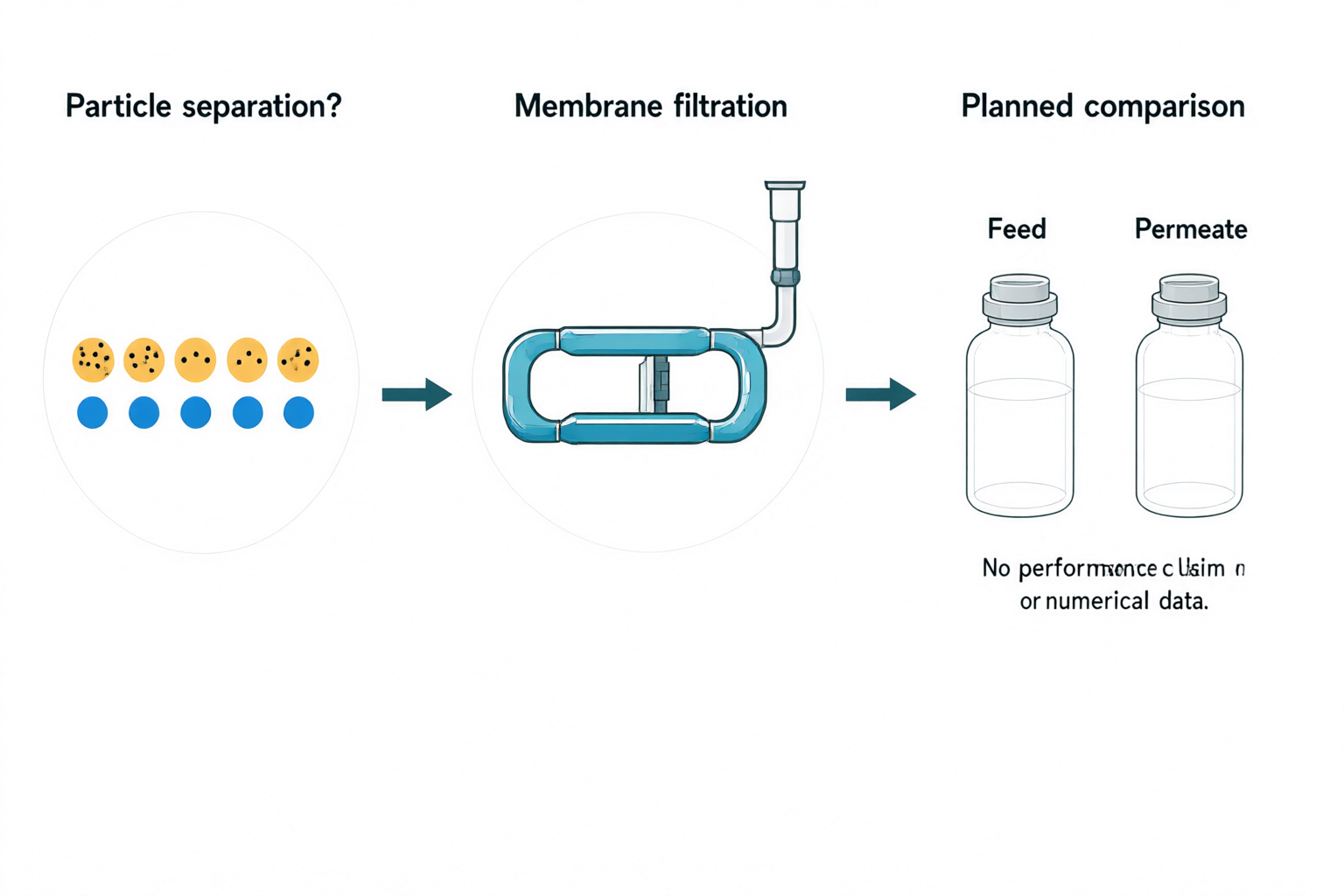
Membrane filtration study design showing a particle-separation question, filtration apparatus and a planned feed-versus-permeate comparison.
PNG originalqwen-image-3.0 · 1536 × 1024

Referência redesenhada externamente
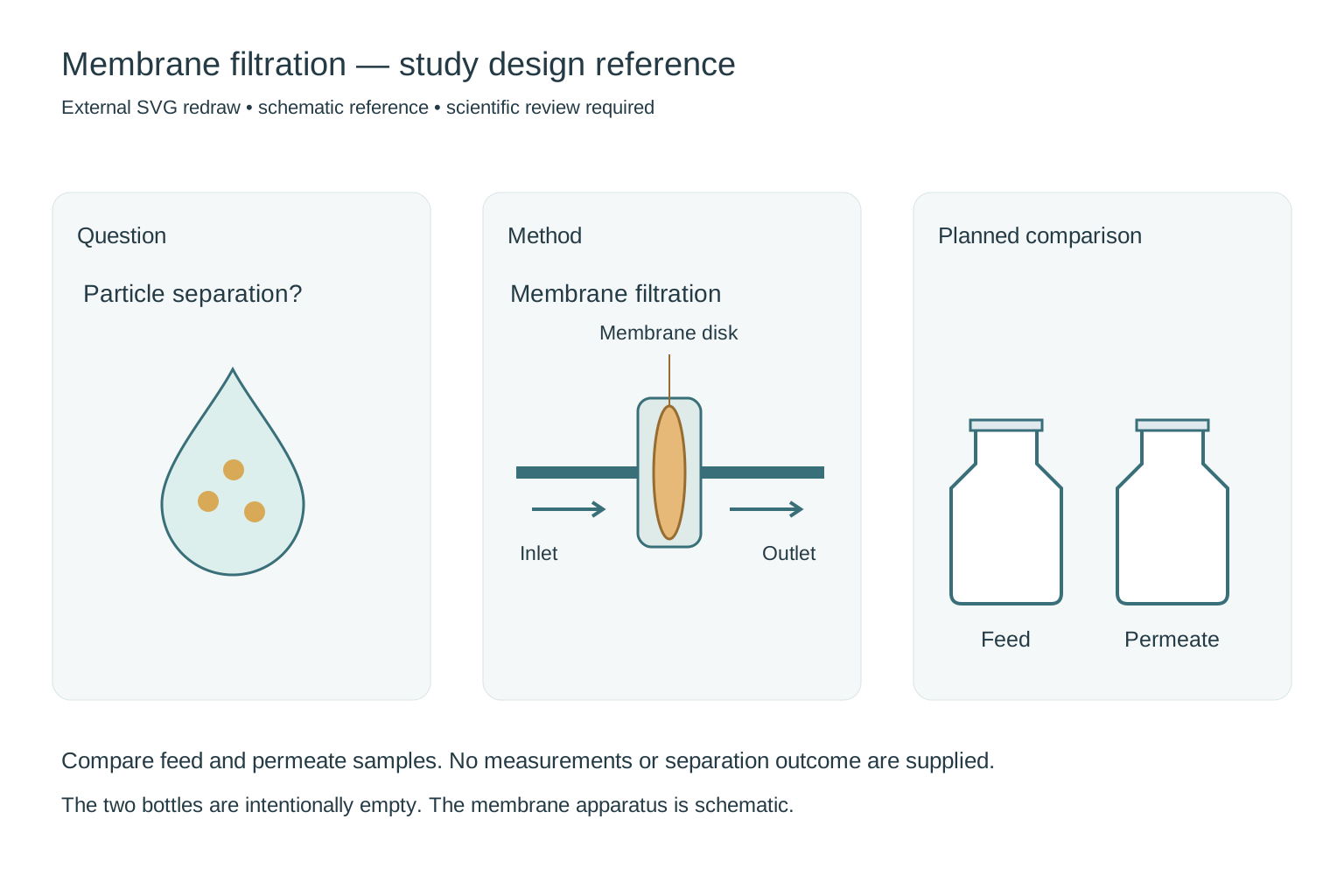
External redraw showing a clearly labeled membrane disk between inlet and outlet, followed by identical empty Feed and Permeate bottles.
Redesenho SVG externo para comparação; não é uma saída direta do produto nem um recurso de edição integrado. Ainda requer revisão científica.

Resumo gráfico

Membrane filtration study design

Notas de revisão

The three panels and matching Feed/Permeate bottles communicate a planned comparison. Needs correction: the apparatus does not clearly identify the requested membrane disk and extra text below the bottles is malformed. Redraw the setup and remove the extra text before use. No separation result was supplied.

Referência redesenhada externamente

Redrew and labeled the membrane disk, inlet and outlet. Replaced malformed text with readable labels and kept both comparison bottles empty. This remains a study design without findings.

Descrição e conteúdo confirmado
Pergunta de pesquisa
Particle separation? A water droplet containing three small particle symbols.
Método
Membrane filtration: a flat membrane disk between an inlet and an outlet tube, shown as a schematic apparatus.
Principais resultados
Planned comparison, with no results yet: two identical empty outline sample bottles labeled Feed and Permeate. Keep both bottles unfilled and identical. No performance claim or numerical data.
Instruções visuais · opcional
Minimal textbook diagram with ample whitespace and teal, blue and amber colors. Print ONLY the short labels explicitly listed in the content. No subtitles, paragraphs, footnotes or extra words. These are drawing directions, not text to display. The ONLY visible text is: "Particle separation?", "Membrane filtration", "Planned comparison", "Feed", "Permeate". Use flat vector-style icons in three horizontal panels.
PNG original
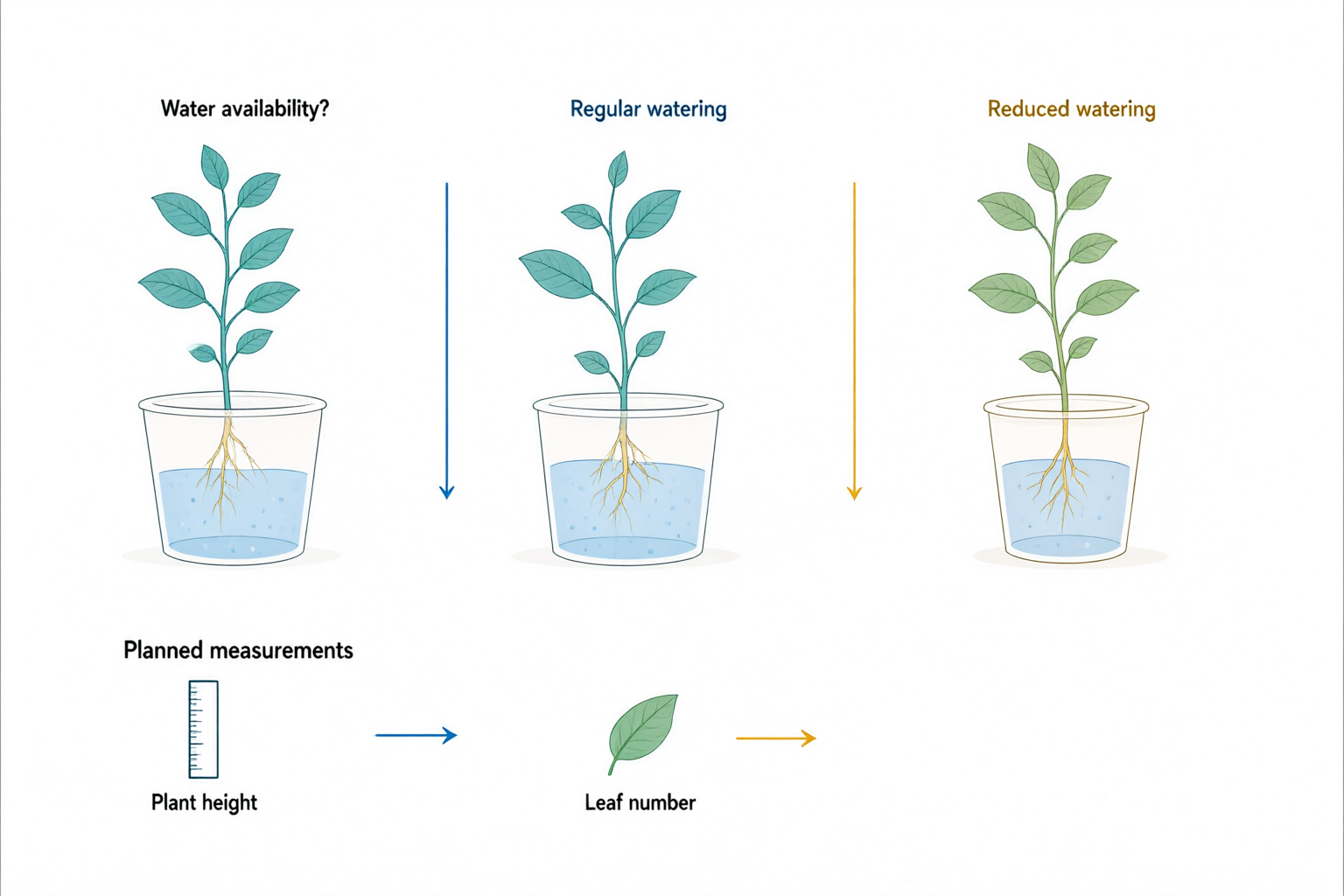
Three schematic plants under water-availability and watering labels, with a ruler and leaf representing planned measurements.
PNG originalqwen-image-3.0 · 1536 × 1024

Referência redesenhada externamente

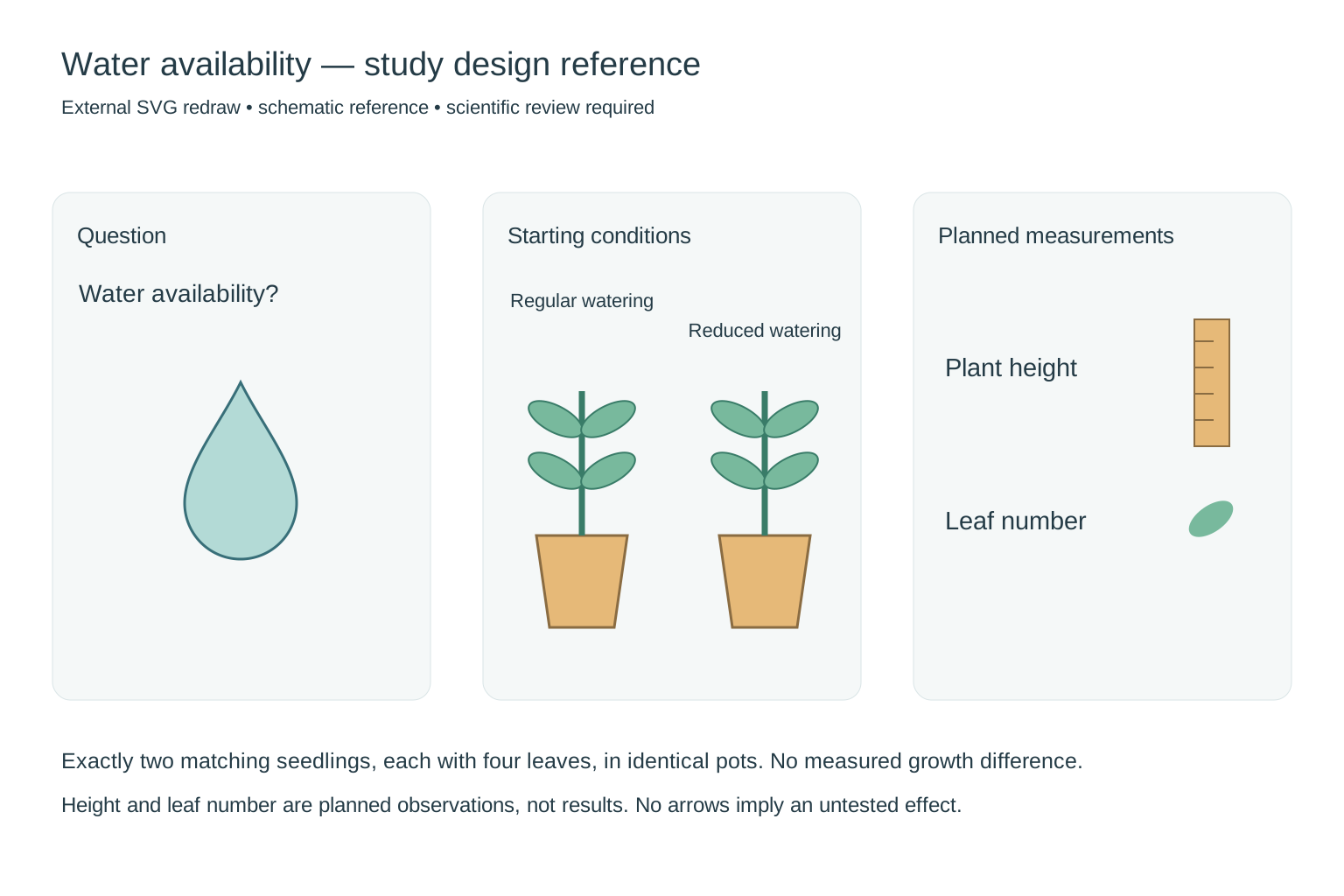
External redraw of two identical four-leaf seedlings in matching pots under regular and reduced watering, with planned height and leaf-count observations.
Redesenho SVG externo para comparação; não é uma saída direta do produto nem um recurso de edição integrado. Ainda requer revisão científica.

Resumo gráfico

Plant water-stress study design

Notas de revisão

The planned measurement labels are readable and no numerical results are shown. Needs correction: the output uses three plants and more than four leaves per seedling, rather than the requested two matching four-leaf seedlings in pots. Extra arrows near the measurement icons have no defined meaning. These are not observed growth differences.

Referência redesenhada externamente

Reduced the setup to exactly two matching four-leaf seedlings, removed unexplained arrows and separated starting conditions from planned observations. No growth response or treatment result is claimed.

Descrição e conteúdo confirmado
Pergunta de pesquisa
Water availability? A water droplet beside a leaf.
Método
Two identical healthy seedlings, each with four leaves and the same height in matching pots. Label one Regular watering and the other Reduced watering. They represent the starting conditions of a proposed experiment.
Principais resultados
Planned measurements, with no findings yet: a ruler icon labeled Plant height and a leaf icon labeled Leaf number. No numbers, graphs or different plant sizes.
Instruções visuais · opcional
Minimal textbook diagram with ample whitespace and teal, blue and amber colors. Print ONLY the short labels explicitly listed in the content. No subtitles, paragraphs, footnotes or extra words. These are drawing directions, not text to display. The ONLY visible text is: "Water availability?", "Regular watering", "Reduced watering", "Planned measurements", "Plant height", "Leaf number". Use flat vector-style icons in three horizontal panels.
PNG original
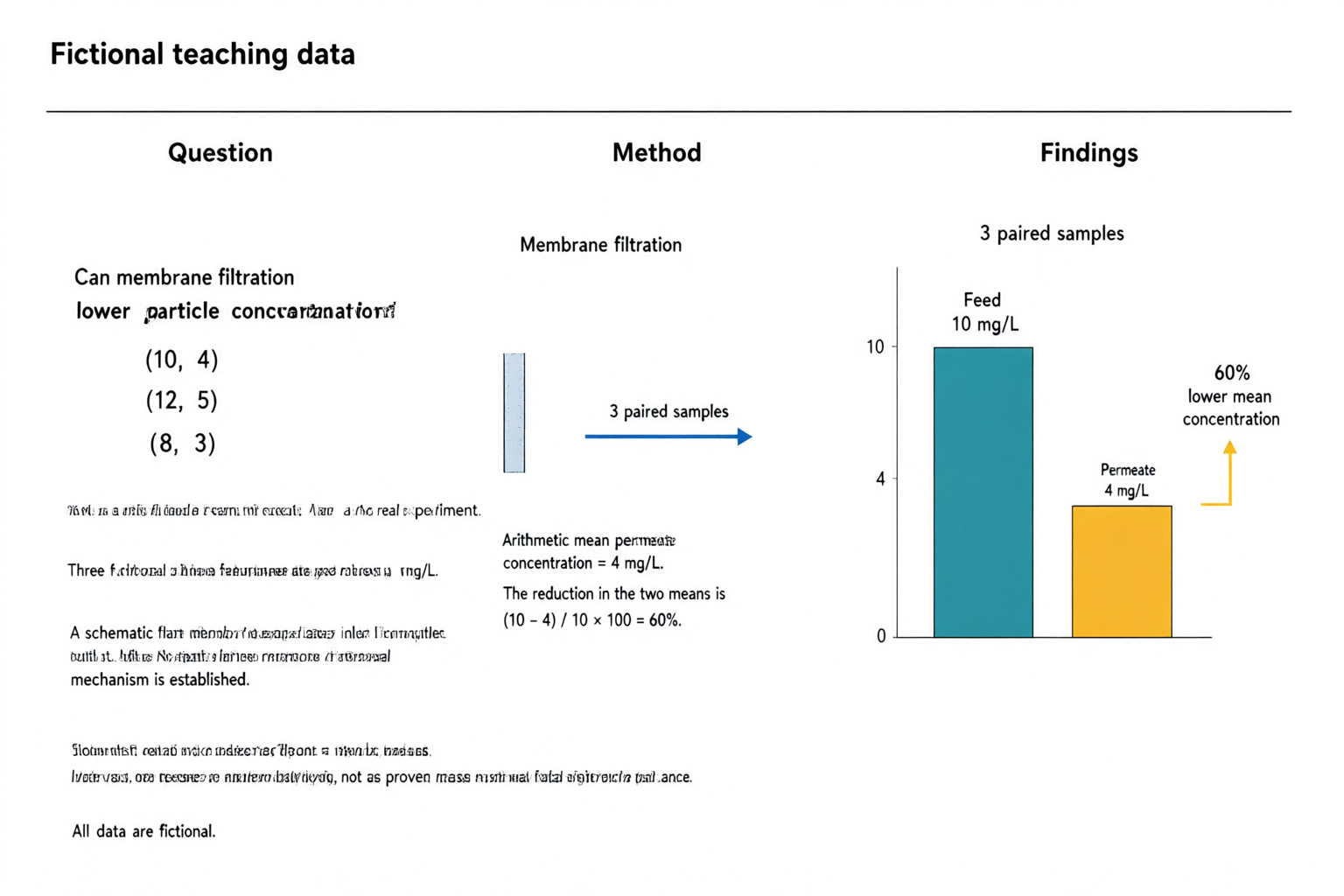
AI-generated fictional teaching abstract with question, filtration method and a zero-baseline chart showing feed at 10 mg/L and permeate at 4 mg/L, with a 60 percent lower mean.
PNG originalqwen-image-3.0 · 1536 × 1024

Referência redesenhada externamente

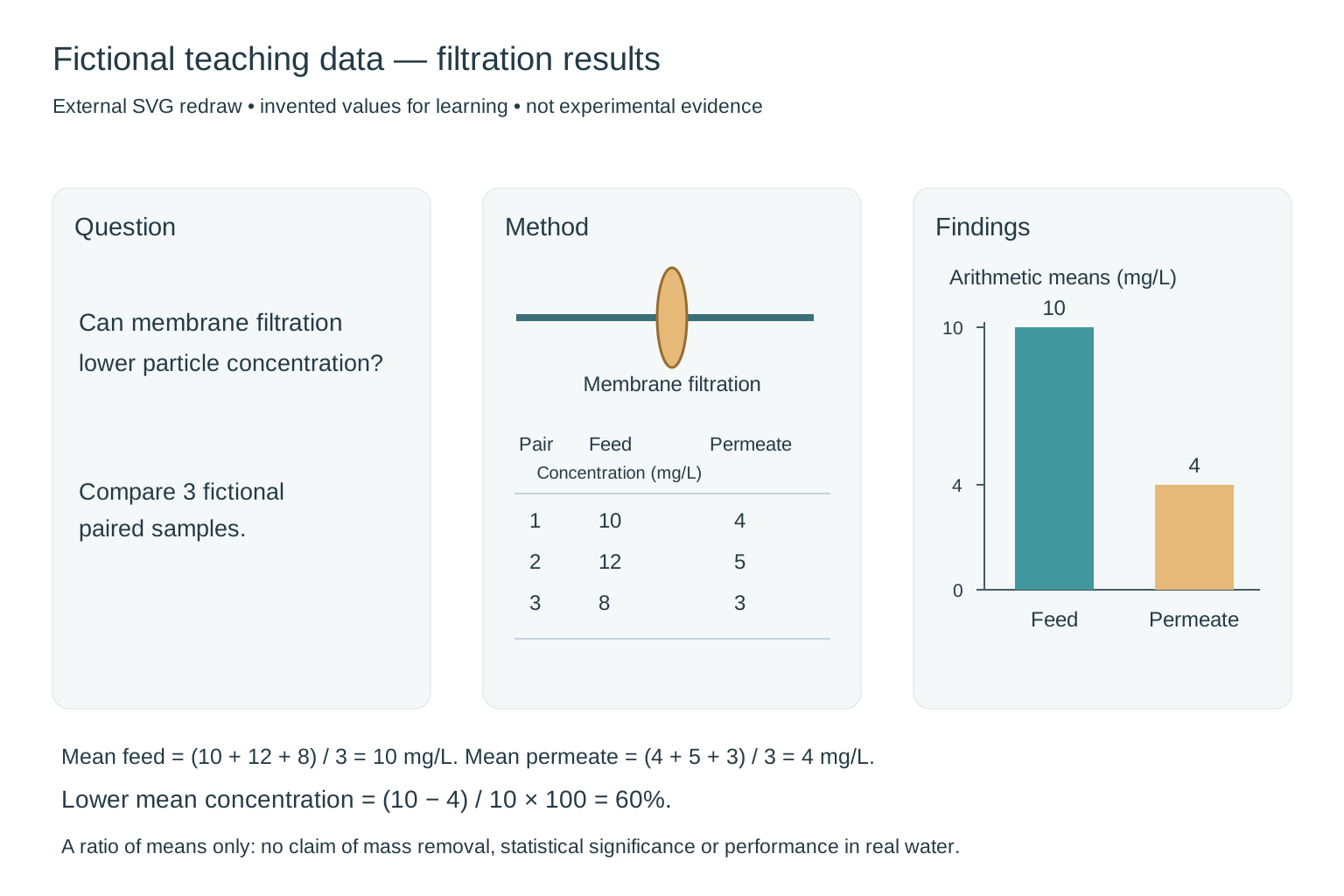
External redraw of a fictional filtration abstract: three paired concentrations 10/4, 12/5 and 8/3 mg/L, arithmetic means 10 and 4, and a chart with a zero baseline and 60 percent lower mean concentration.
Redesenho SVG externo para comparação; não é uma saída direta do produto nem um recurso de edição integrado. Ainda requer revisão científica.

Resumo gráfico

Filtration results — fictional teaching data

Notas de revisão

Fictional teaching data, not experimental evidence. The three feed/permeate pairs are (10, 4), (12, 5), (8, 3) mg/L. Their means are 10 and 4 mg/L, so (10 − 4) / 10 × 100 = 60% lower mean concentration. The original chart preserves these values and a zero baseline, but the extra small text is malformed and the membrane apparatus is incomplete. The 60% is a ratio of means, not proof of mass removal, a mean of individual percentages or statistical significance.

Referência redesenhada externamente

Replaced malformed text with a clear question, a schematic membrane and the complete paired teaching dataset. Redrew the two bars on a shared zero baseline with heights in a 10:4 ratio. Both the figure and its caption identify the data as fictional; no error bars or significance claim are invented.

Descrição e conteúdo confirmado
Pergunta de pesquisa
Can membrane filtration lower particle concentration? This is a fictional teaching example, not a real experiment.
Método
Three fictional paired feed/permeate concentrations in mg/L: (10, 4), (12, 5), (8, 3). A schematic flat membrane separates inlet from outlet. No statistical inference or removal mechanism is established.
Principais resultados
Arithmetic mean feed concentration = 10 mg/L; arithmetic mean permeate concentration = 4 mg/L. The reduction in the two means is (10 - 4) / 10 × 100 = 60%. Show this as lower mean concentration, not as proven mass removal or statistical significance. All data are fictional.
Instruções visuais · opcional
Minimal textbook diagram with ample whitespace and teal, blue and amber colors. Print ONLY the short labels explicitly listed in the content. No subtitles, paragraphs, footnotes or extra words. These are drawing directions, not text to display. Prominently label the whole figure "Fictional teaching data". Three panels: Question, Method, Findings. ONLY additional labels: "Membrane filtration", "3 paired samples", "Feed: 10 mg/L", "Permeate: 4 mg/L", "60% lower mean concentration". Use a simple two-bar chart with a zero baseline, feed bar height 10 and permeate bar height 4. No other numerical claims.
PNG original

COMECE COM UMA IDEIA

Comece com um resumo de demonstração

Estas são entradas de demonstração, não resultados gerados nem pesquisas de clientes.

DA DESCRIÇÃO AO RASCUNHO

Do resumo ao panorama visual

Cole seu resumo, extraia trechos exatos e confira a pergunta de pesquisa, o método e os resultados. Preencha as informações ausentes, escolha um layout e confirme o conteúdo antes de gerar. O gerador de resumos gráficos usa os pontos confirmados para organizar a imagem.

  1. Cole o resumo do artigo ou da pesquisa
  2. Revise a pergunta, o método e os resultados extraídos
  3. Gere, revise o conteúdo científico e baixe

Confira o conteúdo científico antes de exportar

Revise cada rótulo, seta, número e afirmação científica antes de usar. Esta imagem é um rascunho, não uma evidência experimental.

Compare cada trecho com o resumo. Preserve os números, as unidades e o sentido das comparações. Preencha as informações ausentes com base na sua pesquisa antes de continuar.

Revise o significado científico e o texto e verifique as exigências do periódico escolhido sobre IA, licenciamento e declaração de uso. As imagens geradas não são automaticamente precisas, aprovadas por um periódico ou adequadas como evidências experimentais.

Altere o texto, as instruções de layout ou os rótulos e gere uma nova imagem. Esta primeira versão produz imagens raster PNG; não permite edição direta de texto, vetores ou elementos. Cada nova geração pode alterar toda a composição.

Precisa de uma ilustração científica independente? Experimente o gerador de figuras →

Perguntas frequentes

O que devo incluir no meu resumo de pesquisa?

Inclua a pergunta de pesquisa, o método e os resultados reais. Preserve os números, as unidades e as comparações que deseja comunicar. Preencha você mesmo as informações ausentes; a ferramenta não inventará um resultado para completar o resumo.

Posso alterar os pontos de pesquisa extraídos?

Sim. O modelo seleciona trechos originais para você revisar. Edite cada campo com base na sua pesquisa, escolha a organização visual e confirme o conteúdo antes de gerar. Você também pode organizar os pontos manualmente.

Posso editar o texto e os rótulos?

Você pode revisar a descrição e os rótulos exatos antes de gerar outra imagem. A edição direta de pixels, camadas de texto, vetores e elementos individuais não está disponível nesta versão.

Quais formatos e tamanhos de exportação são compatíveis?

Os downloads em PNG estão disponíveis em 1024 × 1024, 1536 × 1024 e 1024 × 1536 pixels. Não são oferecidas exportações SVG ou PPTX. Baixe as imagens logo, pois os links do provedor expiram.